
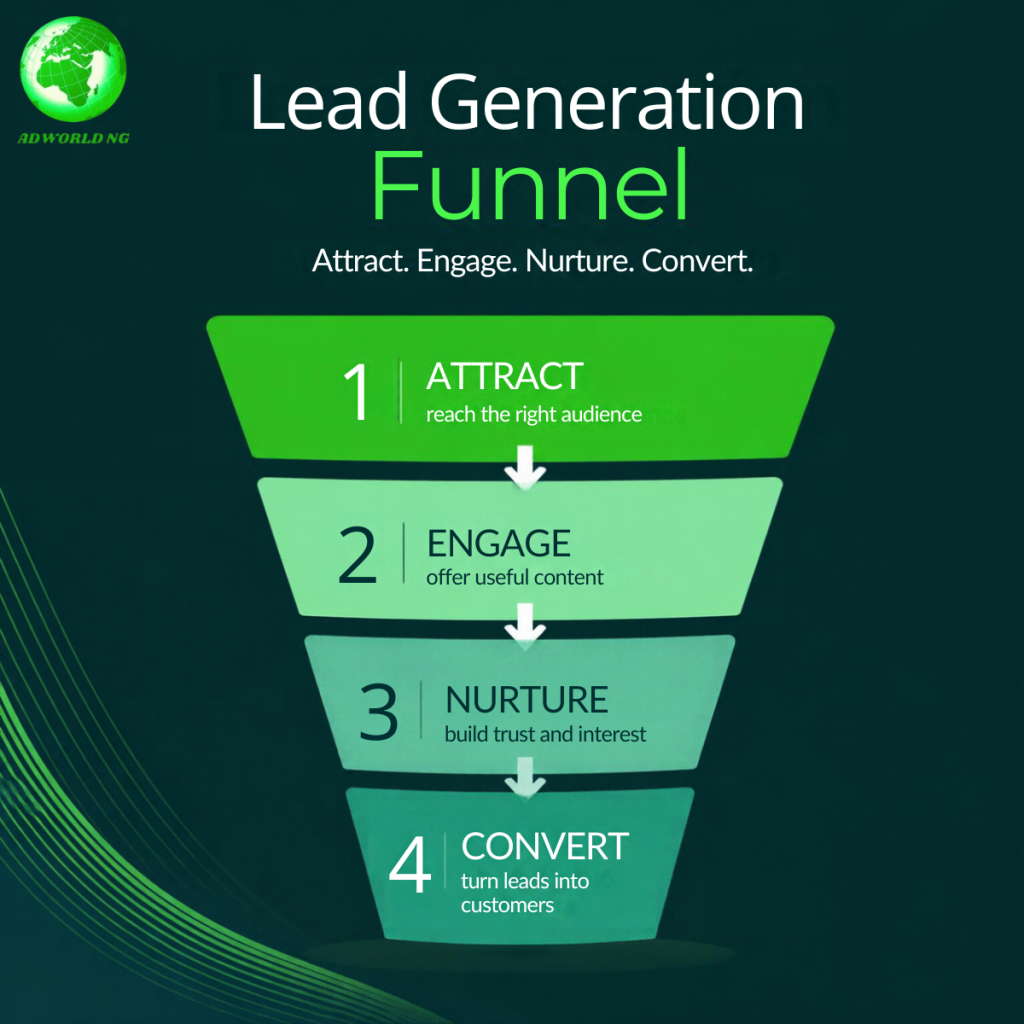
Getting Traffic Is Easy—Turning It Into Customers Is the Real Challenge
Lead Generation & Sales Funnels
Imagine spending money on advertising.
People see your campaign.
They click.
Your website receives visitors.
Your social media page gets new followers.
Your content gets views.
Your videos generate engagement.
And yet, at the end of the month, you are still asking:
“Where are the customers?”
This is one of the most frustrating experiences for business owners.
You can have traffic without sales.
You can have followers without customers.
You can have website visitors without enquiries.
You can have thousands of impressions without a single meaningful conversion.
The problem is not always your marketing.
Sometimes, the problem is what happens after people discover you.
That is where lead generation and sales funnels become important.
Getting someone’s attention is only the beginning.
The real marketing challenge is moving that person from:
Awareness → Interest → Trust → Lead → Customer → Repeat Customer → Advocate
A lead generation funnel provides the structure for making that journey possible.
What Is a Lead Generation Funnel?
A lead generation funnel is a strategic process designed to attract potential customers, capture their interest and information, nurture the relationship and eventually move qualified prospects toward a purchase or other desired action.
In simple terms:
A funnel helps you turn strangers into prospects and prospects into customers.
The word “funnel” is used because you may start with a large audience at the top, while only a smaller percentage eventually becomes paying customers.
For example:
10,000 people see your content
↓
2,000 engage
↓
500 visit your website
↓
100 enquire or submit their details
↓
40 become qualified leads
↓
15 become customers
The exact numbers will vary significantly by business, industry, offer, audience and campaign.
But the principle remains the same.
Not everyone who discovers your business will buy immediately.
Your job is to create a journey that helps the right people move forward.
Traffic Is Not the Same as Demand
One of the biggest misconceptions in digital marketing is that more traffic automatically means more sales.
It doesn’t.
Traffic simply means people are arriving somewhere.
What matters is who they are, why they came, what they find when they arrive and what happens next.
Imagine a restaurant receiving 1,000 visitors to its website every month.
Sounds promising.
But if those visitors are looking for recipes while the restaurant wants table reservations, the traffic may have limited commercial value.
Similarly, an accounting firm may receive thousands of visitors searching for free accounting templates.
Those visitors may not necessarily be ready to pay for professional accounting services.
This is why businesses need to distinguish between:
Traffic
and
Relevant traffic.
And even relevant traffic needs a path toward conversion.
The Funnel Begins With the Right Audience
A funnel cannot fix an audience problem.
If you attract the wrong people, you can build the most beautiful funnel in the world and still struggle to generate quality customers.
Before creating campaigns, businesses should understand:
- Who is the ideal customer?
- What problem are they experiencing?
- What are they trying to achieve?
- What questions are they asking?
- What alternatives are they considering?
- What prevents them from buying?
- What motivates them to take action?
- Where do they spend time online?
- What information do they need before trusting a business?
This is why effective lead generation starts with customer understanding, not advertising.
The objective is not to attract everybody.
It is to attract people who have a genuine possibility of becoming customers.
The Four Main Stages of a Lead Generation Funnel
A simple funnel can be divided into four major stages:
1. Awareness
People discover your brand.
They may encounter you through:
- Google search
- Social media
- Paid advertising
- YouTube
- Blogs
- PR
- Influencer partnerships
- Referrals
- Online communities
At this stage, people may not know you.
Your job is to earn attention.
2. Consideration
Now the potential customer is interested.
They may visit your website.
They may follow your social media page.
They may read your articles.
They may watch your videos.
They may compare your business with competitors.
At this stage, your job is to build understanding and trust.
3. Conversion
The prospect is ready to take a meaningful action.
That could be:
- Booking a consultation
- Requesting a quote
- Starting a free trial
- Purchasing a product
- Registering for an event
- Sending a WhatsApp message
- Calling your business
- Completing a form
Your job is to make the next step clear and easy.
4. Retention and Advocacy
The funnel should not end when someone buys.
The customer experience after purchase can determine whether that person:
- buys again;
- leaves a review;
- recommends you;
- shares your content;
- becomes a loyal customer;
- or disappears forever.
The modern funnel therefore looks less like a straight line and more like a cycle.
Attract → Engage → Convert → Retain → Advocate → Attract
Your existing customers can become part of your future marketing.
Why Every Business Needs a Funnel
Without a funnel, marketing can become a collection of disconnected activities.
You post on Instagram.
You run an advert.
You publish a blog article.
You send an email.
You update your website.
But what happens next?
Where does the person go?
What action should they take?
How do you capture their interest?
How do you follow up?
How do you know whether they are ready to buy?
A funnel answers those questions.
It gives your marketing a direction.
Instead of simply saying:
“We need more visibility.”
You can start asking:
“How do we turn our visibility into qualified leads?”
That is a much more commercially useful question.
Lead Generation Is About Creating Opportunities
A lead is not necessarily a customer.
This distinction is important.
Someone who downloads your free guide may be a lead.
Someone who fills out your consultation form may be a lead.
Someone who sends a WhatsApp message asking about your service may be a lead.
Someone who requests a quotation may be a lead.
But these people may have very different levels of buying intent.
This means businesses should not only count leads.
They should understand lead quality.
Ten highly relevant leads can sometimes be more commercially valuable than 1,000 poorly targeted enquiries.
The goal is not to generate the largest possible number of leads.
The goal is to generate useful opportunities for the business.
Your Lead Magnet Can Open the Door
A lead magnet is something valuable that a business offers in exchange for a prospect’s contact information or another meaningful action.
Examples include:
- Free guides
- Checklists
- Templates
- Industry reports
- Webinars
- E-books
- Calculators
- Free consultations
- Audits
- Product demos
- Educational resources
For example, a digital marketing agency could offer:
“The Small Business Digital Marketing Checklist: 25 Things to Fix Before You Spend Money on Ads.”
Someone who downloads it has demonstrated some interest in digital marketing.
The business now has an opportunity to nurture that relationship.
But the lead magnet needs to be relevant.
Offering something unrelated simply to collect email addresses may produce numbers without meaningful commercial value.
Your Landing Page Has One Job
A landing page should not make visitors work too hard to understand what you want them to do.
A good landing page should answer several basic questions quickly:
What is this?
Who is it for?
What problem does it solve?
Why should I care?
Why should I trust you?
What should I do next?
If someone clicks an advert promising:
“Get a Free 30-Minute Business Growth Consultation”
and lands on a generic homepage containing twenty different services, multiple menus and no obvious booking option, the journey becomes unnecessarily difficult.
Your landing page should continue the conversation started by your campaign.
The Message Must Match the Journey
One of the most common funnel mistakes is a disconnect between the advertisement and the landing page.
Imagine your advert says:
“Get 20% Off Your First Order.”
The customer clicks.
The landing page says:
“Welcome to Our Business.”
The customer now has to search for the offer.
That creates friction.
A better experience would continue the same message:
“Get 20% Off Your First Order — Here’s How It Works.”
The customer’s expectations are immediately reinforced.
This principle is sometimes called message match.
Your advertisement, landing page, offer and call to action should tell the same story.
Calls to Action Should Be Clear
A customer should not have to guess what to do next.
Weak calls to action include vague phrases such as:
“Learn More.”
“Click Here.”
“Check Us Out.”
These can work in certain contexts, but more specific calls to action can make the desired next step clearer.
For example:
Book Your Consultation
Request a Quote
Start Your Free Trial
Get the Pricing Guide
Order Now
Speak With Our Team
Download the Checklist
The right CTA depends on where the customer is in the funnel.
Someone who has just discovered your brand may not be ready to “Buy Now.”
They may be more receptive to:
Learn How It Works
or
Get the Free Guide.
The deeper they move into the funnel, the stronger the conversion action can become.
Trust Is a Conversion Tool
People do not only ask:
“Do I want this?”
They also ask:
“Can I trust this business?”
This is especially important online because customers may be dealing with businesses they have never met physically.
Your funnel should therefore provide evidence that reduces uncertainty.
Useful trust signals can include:
- Customer reviews
- Testimonials
- Case studies
- Portfolio examples
- Client logos where appropriate
- Industry credentials
- Clear contact information
- Transparent pricing where suitable
- Guarantees or clear policies
- Secure payment options
- Professional website
- Media features
- Demonstrations
- Frequently asked questions
Trust should not be manufactured.
It should be demonstrated.
Your Content Should Answer Buying Questions
Good funnel content does more than generate engagement.
It addresses the questions that prevent people from buying.
For example, someone considering a ₦500,000 service may ask:
Why does it cost this much?
What exactly will I receive?
How long will it take?
Have you worked with businesses like mine?
What happens if something goes wrong?
How is your service different?
Your content can answer these questions before the customer ever speaks to your sales team.
That is one reason educational content is so valuable.
It reduces uncertainty.
SEO Can Feed Your Funnel
Search engine optimisation is often treated as a traffic strategy.
But it can also become a lead-generation strategy.
Suppose someone searches:
“How much does social media management cost in Nigeria?”
A marketing agency could create a detailed article answering that question.
Within the article, it could offer:
- a social media planning template;
- a consultation;
- a service page;
- a downloadable pricing guide;
- a campaign assessment.
The visitor came through search.
The content provided the answer.
The CTA created the opportunity.
The funnel moved the person from information to potential business relationship.
That is SEO working with lead generation.
Social Media Can Feed the Funnel Too
Your social media content should not always end with:
“Like, comment and share.”
Sometimes the next step should be deeper.
For example:
Educational post → Free guide
Case study → Consultation
Product demonstration → Product page
Customer story → Purchase page
Industry insight → Newsletter
Webinar promotion → Registration page
Social media creates attention.
Your funnel gives that attention somewhere useful to go.
Paid Ads Can Accelerate the Funnel
Advertising can help businesses reach relevant audiences faster.
But advertising should be connected to a conversion system.
Instead of:
Ad → Homepage
consider:
Ad → Relevant landing page → Lead capture → Nurturing → Sales conversation
This creates a clearer journey.
Different campaigns can also target different funnel stages.
Top-of-Funnel Campaigns
Focus on awareness and discovery.
Examples:
- Educational videos
- Industry insights
- Problem-focused content
- Brand awareness campaigns
Middle-of-Funnel Campaigns
Focus on consideration and trust.
Examples:
- Case studies
- Testimonials
- Product demonstrations
- Webinars
- Comparison guides
Bottom-of-Funnel Campaigns
Focus on conversion.
Examples:
- Consultation offers
- Product promotions
- Free trials
- Quote requests
- Limited-time offers where appropriate
This allows businesses to communicate differently with people depending on how familiar they are with the brand.
Don’t Forget Lead Nurturing
One of the biggest mistakes businesses make is expecting every lead to buy immediately.
They won’t.
Some people need more time.
Some need more information.
Some are comparing competitors.
Some need approval from a partner, manager or finance team.
Some simply are not ready yet.
This is where lead nurturing comes in.
A lead-nurturing sequence could include:
Welcome message
↓
Educational content
↓
Problem-solving resource
↓
Case study
↓
Testimonial
↓
Offer
↓
Follow-up
The exact sequence should depend on the business and customer journey.
The principle is simple:
Don’t abandon interested people simply because they didn’t buy today.
WhatsApp Can Be Part of the Funnel
For many Nigerian businesses, WhatsApp is an important communication and sales channel.
A potential customer may discover your business through Instagram but prefer to ask questions on WhatsApp.
That means WhatsApp can become part of the funnel.
For example:
Instagram Ad → Landing Page → WhatsApp → Sales Conversation → Payment → Follow-Up
The key is to make sure the transition is smooth.
If a customer sends a message and waits two days for a response, the funnel has a problem.
Lead generation does not end when someone submits their details.
It continues through the sales process.
Your Sales Team Is Part of the Funnel
Marketing can generate an excellent lead.
But if the sales process is poor, the lead may still disappear.
Marketing and sales therefore need to work together.
The marketing team should understand:
- What makes a lead qualified?
- What questions do prospects ask?
- Why do prospects decline?
- Which offers generate serious enquiries?
- Which leads convert?
- Which audiences produce repeat customers?
The sales team should also understand the campaigns generating those leads.
When marketing and sales operate in isolation, valuable information gets lost.
When they collaborate, the funnel becomes stronger.
Measure Where People Drop Off
Your funnel should be measurable.
Suppose:
10,000 people see your advert.
1,000 click.
200 visit your landing page.
50 submit their information.
20 become qualified leads.
5 purchase.
Where is the biggest opportunity?
You need the data to answer that.
Maybe the advertisement has a low click-through rate.
Maybe the landing page has poor conversion.
Maybe the leads are not qualified.
Maybe the sales team is struggling to close.
Maybe the offer itself needs work.
Without funnel measurement, businesses often respond by simply spending more money.
But more traffic will not necessarily solve a conversion problem.
Sometimes the answer is to improve the middle of the funnel, not increase the top.
Important Funnel Metrics
Depending on your business model, useful metrics can include:
- Impressions
- Reach
- Click-through rate
- Website traffic
- Landing-page conversion rate
- Cost per lead
- Number of leads
- Qualified lead rate
- Lead-to-customer conversion rate
- Customer acquisition cost
- Sales conversion rate
- Average order value
- Customer lifetime value
- Return on advertising spend
- Repeat purchase rate
The goal is not to track every possible metric.
The goal is to identify the numbers that help you understand and improve your customer journey.
A Funnel Should Be Built Around the Offer
Sometimes the funnel is not the problem.
The offer is.
If your product does not solve a meaningful problem, if the value is unclear, if the pricing does not make sense to your target market, or if the offer is poorly positioned, changing your landing-page button will not magically solve everything.
A strong funnel amplifies a compelling offer.
It does not replace one.
Ask:
What exactly are we offering?
Who needs it?
Why do they need it now?
What makes our solution useful?
What evidence supports our promise?
What makes the next step easy?
Your funnel should make the value of the offer easier to understand.
Don’t Build a Complicated Funnel Just Because You Can
More stages do not automatically mean better results.
A small business may not need a twelve-step automated funnel.
Sometimes a simple journey works:
Social Media → WhatsApp → Consultation → Purchase
Another business may need:
SEO → Blog → Lead Magnet → Email Sequence → Webinar → Consultation → Proposal → Sale
The appropriate funnel depends on the complexity of the buying decision.
A ₦5,000 product may require very little nurturing.
A ₦5 million business service may require significantly more education, trust and sales interaction.
Build the funnel your customer needs.
Not the funnel that looks impressive on a diagram.
Your Funnel Should Continue After the Sale
A customer who has already purchased should not be treated as the end of the journey.
The post-purchase stage can create opportunities for:
- Repeat purchases
- Upselling
- Cross-selling
- Referrals
- Reviews
- Testimonials
- User-generated content
- Loyalty
- Advocacy
For example, after someone buys a product, you could send:
Thank-you message → Usage guide → Customer support → Review request → Related offer
The customer receives support while the business creates opportunities for continued engagement.
This is where lead generation connects with customer experience.
From Funnel to Flywheel
Traditional marketing often presents the funnel as:
Awareness → Consideration → Purchase
But businesses can think beyond the first purchase.
A satisfied customer can generate a review.
The review can influence another prospect.
That prospect becomes a customer.
The new customer has a positive experience.
They recommend the business.
Another person discovers the recommendation.
The cycle continues.
This creates something closer to a growth flywheel.
Your customers can become part of your acquisition strategy.
That is why customer experience, reputation management and lead generation should not be treated as completely separate disciplines.
They influence one another.
The ADWORLD NG Lead Generation Framework
At ADWORLD NG, we believe lead generation should be connected to the wider marketing strategy.
Our approach can be simplified into seven stages:
1. Attract
Use SEO, content, social media, PR, advertising and other relevant channels to reach the right audience.
2. Engage
Give people useful information that addresses their problems and interests.
3. Capture
Provide a clear opportunity for interested prospects to become leads.
4. Nurture
Continue the relationship with relevant content, communication and trust-building.
5. Convert
Make the buying or enquiry process simple, clear and compelling.
6. Retain
Deliver a customer experience that gives people reasons to stay.
7. Amplify
Encourage satisfied customers to become reviewers, referrers and advocates.
This creates a complete growth journey rather than a campaign that ends after the first conversion.
The Biggest Lead Generation Mistakes Businesses Make
1. Chasing Traffic Instead of Customers
More visitors are not necessarily better if they are the wrong visitors.
2. Sending Every Advert to the Homepage
Different campaigns need relevant destinations.
3. Having Weak Calls to Action
If customers do not know what to do next, many will simply leave.
4. Asking for Too Much Information
Long forms can create unnecessary friction.
Only request information you genuinely need.
5. Ignoring Mobile Users
A significant amount of digital activity happens on mobile devices, so your pages and forms should provide a smooth mobile experience.
6. Failing to Follow Up
A lead that receives no response can quickly become a lost opportunity.
7. Measuring Only Likes and Impressions
Visibility matters, but businesses also need to understand leads, conversions and revenue.
8. Treating Every Lead the Same
Different prospects have different needs, intent and buying timelines.
9. Forgetting Existing Customers
Acquiring another customer is not always the only growth opportunity. Existing customers can provide repeat revenue and referrals.
10. Changing Strategies Too Quickly
Some campaigns need testing and optimisation before conclusions can be drawn. Businesses should distinguish between a campaign that needs improvement and one that has not been given enough time or the right conditions to perform.
Your Marketing Should Answer One Important Question
After someone discovers your business, what happens next?
If the answer is:
“Hopefully, they buy,”
you don’t have a strategy.
You have hope.
A strong digital marketing strategy creates a deliberate pathway.
Someone discovers your content.
They find something useful.
They become interested.
They explore your business.
They encounter proof.
They take a small action.
You capture the relationship.
You nurture it.
They become a customer.
You deliver a great experience.
They return.
They recommend you.
That is what a funnel is designed to facilitate.
Don’t Just Generate Traffic. Generate Opportunities.
Traffic is exciting.
A spike in website visitors feels good.
A viral video feels good.
A thousand new followers feels good.
But business growth requires more than attention.
It requires a pathway from attention to action.
Your marketing should not simply ask:
“How many people saw us?”
It should ask:
“How many of the right people did we attract?”
“How many showed genuine interest?”
“How many became leads?”
“How many leads became customers?”
“How many customers came back?”
“How many customers recommended us?”
That is the difference between having digital visibility and building a digital growth system.
At ADWORLD NG, we help businesses connect strategy, content, SEO, social media, advertising, lead generation, customer experience and conversion into marketing solutions designed to move audiences closer to action.
Don’t just drive traffic. Give it somewhere to go.
Let’s build a funnel that turns attention into opportunities — and opportunities into sustainable business growth.
Frequently Asked Questions
1. What is lead generation?
Lead generation is the process of attracting potential customers and encouraging interested people to take an action that allows a business to continue the relationship, such as submitting an enquiry, booking a consultation, signing up for a newsletter or requesting a quote.
2. What is a sales funnel?
A sales funnel represents the stages a potential customer moves through before and after making a purchase, from awareness and consideration to conversion, retention and advocacy.
3. Why is a lead generation funnel important?
It gives businesses a structured way to turn marketing attention into measurable opportunities. Instead of simply attracting visitors, the business creates a pathway for qualifying, nurturing and converting relevant prospects.
4. Can social media generate leads?
Yes. Social media can generate leads through educational content, advertisements, lead forms, direct messages, landing pages, webinars, offers and other conversion mechanisms. However, the specific approach should match the audience and business model.
5. Does every business need a complicated sales funnel?
No. A funnel should reflect the complexity of the customer’s buying journey. Some businesses may need a simple social-media-to-WhatsApp journey, while others may require several stages of education, nurturing and sales interaction.
6. How can I tell whether my funnel is working?
Track relevant stages of the journey, including traffic, engagement, landing-page conversion, lead volume, lead quality, sales conversion, customer acquisition cost and revenue. The right metrics depend on the business model and objectives.
7. Can ADWORLD NG help businesses build lead-generation funnels?
Yes. ADWORLD NG can help businesses develop integrated marketing strategies that connect audience targeting, content, SEO, social media, advertising, landing pages, lead generation, conversion and customer experience.